

Articles
Dizzy When Standing Up on Low-Carb? What to Check
If you feel dizzy when standing up on low-carb, the timing is worth paying attention to. Feeling fine while you are sitting, then swimmy the moment you get out of bed or up off the sofa, is a different thing from feeling dizzy all day. It is also different again from the room spinning.
That pattern is useful information. It does not tell you the cause on its own. A change in blood pressure when you stand is one possibility. So are hydration, medication, an illness you are getting over, blood sugar and heart rhythm. The first move is not to work out which one it is. It is to notice exactly what happens, and write it down.

Why standing up can leave you lightheaded
When you stand, gravity pulls blood down toward your legs and abdomen. Your body normally corrects for that within a second or two by adjusting your heart rate and tightening blood vessels, so your brain keeps its supply.
When that correction is slow or incomplete, you get a short window where you might feel faint, weak, unsteady, or as though your vision is dimming and you need to sit straight back down.
There is a clinical name for one version of this. The American Heart Association's 2024 scientific statement on orthostatic hypotension defines it as a sustained drop of at least 20 mmHg systolic or 10 mmHg diastolic within three minutes of standing, and describes it as common among adults with uncontrolled high blood pressure.
That last part catches people out. You can have high blood pressure and still have a real drop when you stand. The two are not opposites, and one does not rule out the other.
Lightheaded or spinning? They are not the same thing
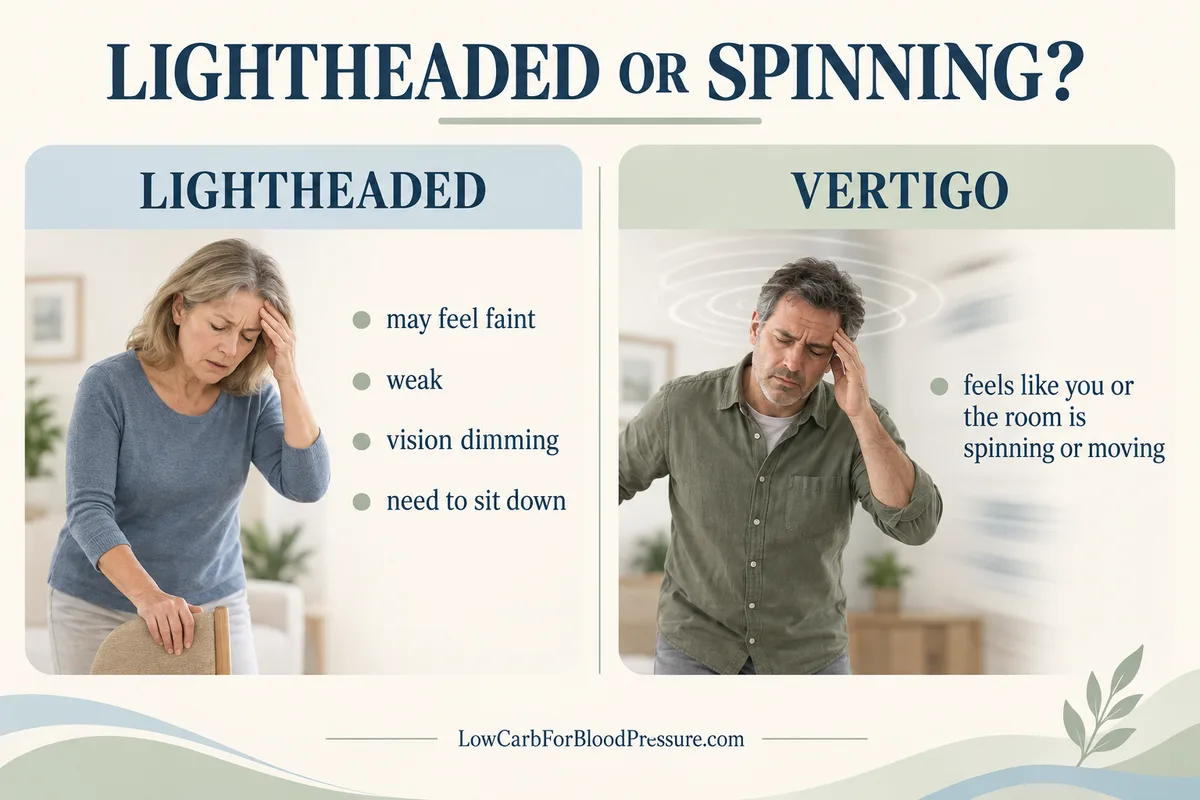
“Dizzy” covers several different sensations, and telling them apart matters more than most people expect, because it changes what a doctor looks at first.
Lightheaded
MedlinePlus puts it plainly: lightheadedness is the feeling that you might faint. Head empty or floaty, vision briefly dimming, legs weak, a strong sense that you should sit down. It lists a sudden drop in blood pressure among the causes, alongside dehydration, getting up too quickly after sitting or lying down, low blood sugar, medicines that lower blood pressure, and heart problems.
Spinning
Vertigo is a different thing. MedlinePlus describes it as the feeling that you are spinning or moving, or that the world is spinning around you. If the room tips when you turn your head or roll over in bed, do not file that under low-carb dizziness. Use the word spinning when you describe it. It points somewhere else, often the inner ear, and it is assessed differently.
Low-carb may be part of it. That is not the same as proof.
Lightheadedness is genuinely common in the first weeks of a strict low-carb or ketogenic diet. A 2025 scoping review of symptoms during keto initiation found it reported in roughly 15 to 21 percent of adults. The usual explanation is that the kidneys let go of more sodium and water early on.
Here is the part that rarely gets passed along with that explanation. The same review states that the authors did not identify any single study documenting both the symptoms and the matching changes in sodium, potassium or body water. A believable mechanism, with the proof of it still missing.
So feeling lightheaded after cutting carbs does not establish that you are short of sodium. It does not mean you automatically need more salt, an electrolyte powder, potassium, or a change to your blood pressure medication.
The broader guide, why you feel dizzy on low-carb, covers the wider set of reasons. This page is about one specific clue: it happens when you stand.
What to write down when it happens
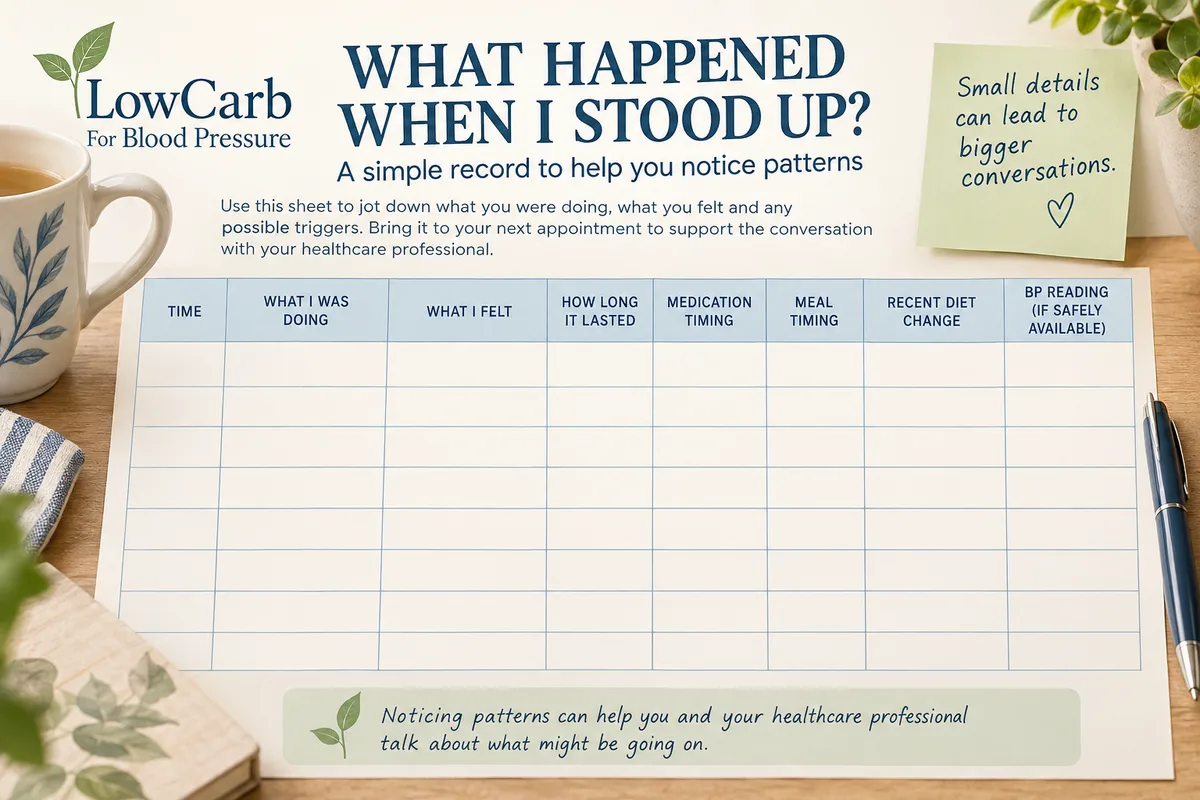
You do not need a health spreadsheet. A note on your phone is enough, and after four or five episodes a shape usually starts to show.
Start with the trigger, because that is the detail people have forgotten by the time they are sitting in front of a doctor. The common ones are getting out of bed in the morning, standing after a long stretch at a desk, getting up from the sofa, standing after a meal, getting up in the night, standing after exercise, and standing after a hot shower.
Then the rest of it:
| What to note | Example |
|---|---|
| Time | 7:10 am |
| What you were doing | Got out of bed |
| What you felt | Lightheaded, vision dimmed |
| How long it lasted | About 15 seconds |
| What helped | Sat back down |
| Medication timing | Tablet at 6:30 am |
| Meal timing | Had not eaten yet |
| Recent diet change | Cut carbs 10 days ago |
| Anything else going on | Hot day, poor sleep, upset stomach |
| Blood pressure reading | Only if you can take one safely |
Note anything that arrives with it, too. Palpitations, a racing or unusually slow heartbeat, nausea, sweating, blurred vision, a stomach upset, a recent medication change, or a near-fall are all worth writing beside the episode rather than mentioning as an afterthought.
The AHA statement makes the point that once this pattern is identified, finding its cause is the important first step. Your notes are what make that possible. They are far more use at an appointment than “I have been dizzy lately.”
Should you check your blood pressure in the moment?
If you already monitor at home, keep taking your usual readings and bring the record with you. But routine home monitoring and a formal standing blood pressure assessment are not the same test, and the second one belongs to your clinician.
For ordinary home readings, the American Heart Association recommends an automatic upper-arm cuff, at least five minutes of quiet rest, no talking, your arm supported at heart level, two readings a minute apart, and taking them at the same time each day.
Two lines from that same page are worth keeping. Home monitoring does not replace regular doctor visits. And do not stop taking blood pressure medication without checking with your healthcare professional, whatever your readings say.
There is another reason not to improvise your own standing test. The AHA statement lists plain measurement error as one of the recognised ways a drop can look real when it is not. So if you feel like you might go over, do not chase a number. Sit down. If your clinician wants lying, sitting and standing readings, they will tell you how to take them. For the everyday technique, how to monitor blood pressure at home covers it.
Salt, supplements and your medication list
Do you need more salt? Not automatically.
This is the assumption I run into most. Someone feels lightheaded, someone else says “keto flu”, and the advice comes back as eat more salt. For a reader managing high blood pressure, kidney disease, heart failure or a fluid restriction, that may be the wrong move. The 2025 review describes a plausible mechanism, not a diagnosis, and it does not establish that any particular person is short of sodium.
If you already have sodium, fluid or electrolyte instructions from your own team, those come first, ahead of anything general you read online. Our guides to how much sodium you really need on low-carb and electrolytes on low-carb go into both properly.
Potassium needs a sentence of its own. Potassium-enriched salt substitutes and potassium supplements are not for everybody. A 2024 review in Hypertension of how clinical guidelines handle them recommends them for people with high blood pressure unless they have advanced kidney disease, already take a potassium supplement, take a potassium-sparing diuretic, or have another contraindication. The UK guidance it quotes is broader still and also names ACE inhibitors and angiotensin II receptor blockers. Guidance genuinely disagrees about where the line sits, which is exactly why that one is a question for your doctor or pharmacist and not for an article.
Your medication list belongs in this conversation
If you have made a real change to how you eat and you are now lightheaded when you stand, bring the whole list: blood pressure medication, diuretics, diabetes medication, anything that affects heart rate, anything added recently.
What not to do is reduce or stop something on the strength of one low reading or one dizzy spell. The evidence here runs the other way to the folk wisdom. A meta-analysis of nine trials in just over 31,000 adults with high blood pressure found that treatment to lower blood pressure did not increase, and may have decreased, the risk of developing this kind of drop on standing. The researchers' own conclusion was that finding it during treatment is not a reason to reduce or stop that treatment.
Cutting carbs can lower blood pressure by itself. Tell your doctor you are making the change so they can keep an eye on your readings, and tell them if you feel lightheaded. That is something to report, not a milestone.
What to do in the moment
When it comes over you:
- Sit or lie down if you feel unsafe. Do not try to walk it off.
- Give it a moment to pass before you stand again, and hold something stable when you do.
- Get up more slowly next time. MedlinePlus advises avoiding sudden changes in posture, and getting up from lying down slowly, sitting for a few moments before you stand.
- Leave driving, ladders and knives until it has fully passed.
- Write it down while it is fresh.
- Tell your doctor if the episodes are frequent, getting worse, or changing what you can do in a day.
When it is not something to note down for later
Some things go straight past the notebook. MedlinePlus says to call for emergency help if dizziness comes with chest pain, an irregular heartbeat, shortness of breath, weakness, an inability to move an arm or leg, changes to your vision or speech, or fainting. Do not sit with any of those to see whether they settle, and do not assume a serious new symptom is simply low-carb dizziness.
Common Questions About Dizziness When Standing Up
Why do I get dizzy when I stand up on low-carb?
A temporary change in blood pressure when you stand is one possibility, but it is not the only one. MedlinePlus also lists dehydration, getting up too quickly, low blood sugar, medicines that lower blood pressure and heart problems among the causes of lightheadedness. The timing narrows it down. It does not settle it.
Does dizziness when standing mean my blood pressure is too low?
Not necessarily. Orthostatic hypotension is a specific drop after standing, and the AHA describes it as common among adults with uncontrolled high blood pressure. So it is possible to have high readings at some times and a meaningful drop at others. That is a pattern for your doctor to interpret, not something to read off one reading at home.
Should I add more salt if I feel dizzy on low-carb?
Do not assume dizziness proves you need sodium. That matters most if you have high blood pressure, kidney disease or heart disease, or take medication that affects fluid or electrolyte balance. If you already have sodium or fluid instructions, follow those and ask your doctor before changing anything.
Can blood pressure tablets cause dizziness when standing?
Medicines that lower blood pressure are on the MedlinePlus list of causes of lightheadedness, so bring your list to the appointment. But a meta-analysis of nine trials found treatment did not increase the risk of this kind of drop, and concluded that finding it is not a reason to reduce or stop treatment. Any change is your prescriber's call.
Is vertigo the same as feeling faint?
No, and the difference is worth getting right. Lightheadedness is the feeling that you might faint, often with your vision dimming. Vertigo is the feeling that you or the world around you is spinning or moving, even when nothing is. They are assessed differently, because vertigo points more often at the inner ear, so say plainly which one you mean.
Should I measure my blood pressure every time I feel dizzy?
Only if you can do it safely and your clinician has asked you to monitor. The AHA statement names measurement error as one way a drop can look real when it is not, so a rushed reading taken while you feel unsteady is not reliable anyway. If you feel like you might fall, sit down first.
Next step
If the dizziness is specifically triggered by standing, the most useful thing you can do this week is keep the record and take it to your doctor, rather than trying to fix it yourself with salt, supplements or a change to your tablets.
For the wider picture of why low-carb can leave you feeling unsteady, why you feel dizzy on low-carb is the place to go next. If you would rather work on the routine around it, the daily habits that support healthy blood pressure pillar covers the steadier rhythms that make these episodes less likely to catch you out.
And if you want a calm place to start, try the free 60-second blood pressure check. It ends with a short plan of your own, and the Blood Pressure Support Cheat Sheet comes with it.
I write from my own experience of living with high blood pressure, not as a medical professional. Nothing here is medical advice, and nothing here should replace what your own doctor tells you. Please talk to them before making changes, especially if you take medication.